Showing posts with label pricing. Show all posts

Sunday, December 25, 2011

Apple iPhone no longer in Blue Ocean Market- Change in Strategy essential


Apple launched iPhone in 2007 which is an internet and multimedia enabled Smartphone with touch screen and has totally redefined the Smartphone market. Apple iPhone has become a cult device and five generations of iPhone models have hit the market till now and Apple sold more than 100 million units till now. With half million applications in app store for the consumers to play with, iPhone is a great device that revolutionized the Smartphone segment with features like a portable media player (iPod), an Internet client with email, web browsing capabilities, multi touch screen, 3G connectivity, camera, etc. iPhone has provided consumers with an unique experience and has generated significant revenues and profits. Apple iPhone created a blue ocean market where it has total control of everything from the product design, pricing, software, app store and development to the way it markets and sells its iPhones. Apple had a created an uncontested market at the high end of the smartphone market and its iPhone has offered the mobile users a very unique experience that has become a benchmark in the smartphone industry that all the other players are trying to achieve. Hardware, software and the developer ecosystem is the best in the world and Apple is dominant player in the application market. Developers love to work on the Apple OS as it is one of the best OS in the world and it allowed them to create numerous applications and make money selling them. Apple developers get 70% revenue of the sales.

Initially only AT&T was authorized to sell the phone but many other carriers across the world are selling. Apple had been able to sell the iPhone at a premium and consumers are more than willing to pay the premium because iPhone was such a magnificent device with functionality and half million applications in the app store that allowed its users to use for everything. Apple has total control on the hardware, software and provided limited access to developers to its code and it tightly restricts the apps on its app stores and allows only apps that are approved by it. Apple has single product and price strategy and focuses all their R&D, engineering, hardware, software efforts on just one product. Apple has the highest profit margin per iPhone and its pricing strategy has been remarkably as it launches its new versions at higher reference price and subsequently lowers the previous versions price. Recently it reduced its iPhone 3GS price to zero with contracts and it is not relying only on hardware sales but also on the sales of apps, music, movies, videos etc on its iTunes store.


Apple iPhone has transformed from a GSM phone to a 3G network capability in second version but the screen size and the home button placement remained as a standard. The 3GS models came with a bigger difference like faster processor, better camera with video and better OS. The iPhone 4 is thinner with a wider brushed stainless steel band, aluminosilicate glass panels, with video conferencing capability, high resolution display and powerful A4processor. The iPhone 4S came with 8 mp camera with video recording, face detection, dual core processor, multi-standard wireless support and a natural language voice control system called Siri. Apple iOS, the operating system initially developed for iPhone has been extended to iPod Touch and iPad. There have been five versions till now and it has been enhanced further with multi tasking capability in fourth version and the OS has been constantly developed to add more functionality and features.

Change in Apple iPhone Strategy
Apple has always believed in quality rather than quantity and focused on the high end premium market. iPhone has been costly when compared to other smartphones but Apple tried to keep the premium pricing close to its competitors premium model price. Initially AT&T was the only carrier selling the iPhones until February 2011 and since then Verizon and Sprint started selling iPhone and in October 2011, C Spire Wireless announced that it would be carrying the iPhone 4S. iPhone was originally launched in six countries in 2007 but now Apple has launched it in around 100 countries.  For the first time Apple has three models of iPhone 3Gs, 4 and 4S with prices ranging from Zero for 3GS with contract, US$ 99 for 4  to US$400 for 4S. Apple has to reduce the price for the older models as the Android Models have flooded the market at the lower price levels and have successfully captured the market and made it the number one in the smartphone market in just three years. Another factor that forced Apple to reduce the price despite good 4S sales and not make the 3GS obsolete is that there has been no wow factor for the 4S model as the consumers were not attracted by the faster chip, better camera and voice activated personal assistant software Siri.

Apple has also been criticized for not having a proper pricing strategy for the emerging markets as iPhones come with huge price tag. There have been a rumors that there will be smaller version of iPhone specifically targeted towards the emerging markets but till now it is no there. But Apple is reducing the price of the older versions of iPhone but these versions are outdated and with less features and functionality compared to the Android phone models that come in all sizes, prices and powerful hardware. Dependency only on the high end market will lead to limited revenue growth but with significant margins. Most of the analysts and Research firms forecast Apple to keep its market share at around 16-18% of smartphone market by 2015. Other Smartphone players like Samsung, RIM, Nokia, and Microsoft are aggressively looking to improve their market shares with new products. Even Android that is holding more than 50% smartphone now is expected to hold around 50% market share by 2015. Initially Apple did not focus much on the enterprise segment but with businesses and other organizations changing their strategy where they are allowing employees to bring in their own devices and integrating them with their IT infrastructure, Apple has a good opportunity to improve sales in this segment. Some of the companies are even buying iPhones as enterprise device for their employees as Blackberry is losing out due to product failures. Apple needs to support its enterprise sales team.

Smartphone market - Red Ocean
Smartphone market has become a big Red Ocean with many mobile makers launching phones that are even more powerful and feature and functionality rich than the iPhone. There has been patent wars going on between all the players and each one of them is trying to block others legally but they are not able to do it. Android, Microsoft and RIM are also invested heavily in their ecosystems and wireless carriers are looking to have multiple eco systems so that they can offer more choice to their customers. Wireless carriers, Google, Microsoft and Mobile phone makers except Apple are looking to convert more mobile phone users to smartphone users. They have been successful in their strategy as the percentage of smartphones has been rising and expected to reach 50% of the total mobile phone market. Apple has to be part of this strategy and look for a less costly iPhone as the reliance only on the high end premium market will always be risky. And there is also a risk that all the other players will bring down the average selling price and no matter how iconic and cult following the brand has Apple will loose the market to its competitors. The success of the Samsung Galaxy phones, HTC Smartphones and the yet to be launched new phones from Microsoft and RIM next years will be deciding factor for the Apple iPhone future success. Smartphone makers are adopting various strategies to survive in the market like collaborating with software developers, investing in R&D for designing new devices with differentiation, attracting more developers to develop more apps and also working closely with wireless carriers to understand the local market dynamics and consumers.

Application store iTunes with Apps was Apple’s another success factor. But now Android has Android Market Place with Apps matching Apple’s app store, Nokia Ovi Store and every mobile manufacturer coming up with their own app stores, Apple is loosing its advantage. Developers are developing for other stores as they are also competitive 70-80% revenue share. Apple also launched another unique offering to its customers which is the iCloud, iPhone users can back up and store their data and content on the cloud. Everybody in the Smartphone market is investing heavily in R&D and realized innovation is must for success in the market. Consumers are looking for powerful devices that offer them more functionality and feature and help them in their day to day life. Mobile manufacturers are launching low price smartphones in the emerging markets that come with essential smartphone features and are pushing them through the wireless carriers with subsidies in price and data plans. Wireless carriers are also upgrading their networks as the smartphones put a lot of pressure on their existing networks and they need to push more smartphone to recover their investments in infrastructure. Marketing and advertising strategy is also essential as the mobile manufacturers have to invest millions to promote the products and educate the consumers about the device functionality and features as they do not have a brand like Apple that is considered to offer most innovative and disruptive products. Under the charismatic leadership of Steve Jobs, Apple has been able to keep customers interested in its iPhone and sell millions of iPhones, but without Steve Jobs one has to see how Apple will do in the coming years. Apple has to keep its innovating and change its strategy according to the consumer needs and also keep a close eye on its competitors.


READ MORE - Apple iPhone no longer in Blue Ocean Market- Change in Strategy essential

Tuesday, November 29, 2011

India Outsourcing Industry- Increasing number of Fixed Price Contracts but Time & Materials Contracts still dominate for Major Vendors

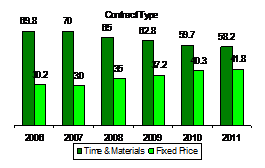
The outsourcing contract is critical document in an outsourcing relationship which typically contains: scope of services, assumptions, deliverables, pricing, intellectual property and deliverable ownership, contract duration, service levels, customer responsibilities, Vendor responsibilities, conflict resolution, and termination process. There were 472 outsourcing deals struck in the third quarter of 2011 compared to 516 transactions in the second quarter of this year according to Everest Group. Indian IT Vendors constantly write contracts with clients every quarter. Indian ITO vendors contracts are based on two types of pricing Time & Materials based pricing and fixed Pricing. Most clients still negotiate for T&M or Fixed Price contracts with T&M contracts more than 51-58% of total revenue and rest is fixed price contracts. Fixed-price projects to mitigate the impact of the rising rupee and wage inflation on their profitability.

Time & Material (T&M) Contracts are the major type of contracts done by the Indian IT Vendors. In the initial days of outsourcing of work to Indian Vendors the outcomes were unknown and both vendors and clients were not sure how effectively the work will be done by the resources provided by the vendors. They were not sure about the time and resources required, hence the T&M contracts were the best options. Clients wanted to have control on the resources and track vendor resources including the approval and clearance of time-sheets and the risks totally existed with the client. In the T&M contracts the risk lies totally with the clients. People are thrown at the problem and are billed on hourly basis and there are instances of unutilized resources in this scenario. Projects can be easily ramped up or down according to the clients needs easily. These contracts are best suited when the relationships between the clients and vendors are just starting fresh and the projects or process are new with no significant view of the outcomes and their impact. As long as uncertainty exist T&M contracts will be there and despite the fact some experts believe the golden age of T&M contracts is going to end in next ten years.

Fixed price (FP) contracts are clearly defined and deliverables agreed between client and vendor. Standard IT procedures, periodic reviews of performance and phased billing are other features of FP contracts. Risk is shared between the vendor and clients and vendors have to invest in the relationship and technologies required. This is a rigid model and mid way changes are difficult to make. Clients have to be very careful in choosing the best vendors for significant ROI and the vendors too have the scope on investing on the infrastructure and technologies as they are well aware of the client needs. Both clients and Vendors have to invest in building a relationship. Fixed price contracts are being favored by the Indian ITO vendors as they can efficiently complete the work using lesser resources and do it without much interference from the clients. In the past four years Indian vendors are trying to increase the Fixed price contracts percentage to total revenues as the client IT budgets/spend are being tightened due to the financial crisis, debt crisis and economic slowdown. Indian IT vendors looking to maintain 40-40% of total revenue through fixed price contracts. Fixed-price outsource contract attracts the customers due to immediate cost reduction followed by 3-5 years of cost control. Fixed-price projects are also more short term in nature, while the time and material are long-term contracts that give longer revenue visibility for companies

Tata Consultancy Services Limited
TCS has a higher ratio of fixed prices contracts in comparison to the competition and suggest TCS is undertaking more complex and mission critical end-to-end engagements.TCS has been looking to maintain the fixed price contracts in between 40-50% which they feel is optimal. The recent recession and financial crisis has tightened the client budgets and spends which forced to look for more fixed price as it helps them in controlling the resources and do the work more efficiently. 
TCS also increased the working hours of employees so that they can increase billable hours for T&M contracts. Fixed price contracts also have higher pricing compared to T&M and carry risk for the vendors. Fixed price contracts have to be signed constantly as the existing contracts get completed overtime and if there are no signings for some time then the overall revenue gets impacted. TCS in 2011 is facing such situation where they have seen fall in fixed price signings but confident to overcome as they have good pipeline. Margins also increase with fixed price contracts.


Infosys Limited
Infosys has successfully increased its fixed price contracts since 2008. Financial crisis and subsequent recession forced Infosys to start look for ways to curb the slow revenue growth. The USclients have changed their offshore outsourcing strategy and this prompted Infosys to look for fixed price strategy. But Infosys still have major revenues coming from T&M contracts as most of its clients want to stick with T&M and there are risks involved in fixed price like if the scope of a fixed price bid is unclear, it can lead to cost overruns. The share of fixed price contracts for Infosys in 2010-11 stands at 42% as compared to 28% in 2005-06. Infosys focused on shift to fixed-price contracts as part of the bigger effort to de-link revenue growth from manpower growth and move up the value chain. In long term, Infosys expects the proportion of fixed price bids going up.

Wipro Limited
Over the last 2-3 years, Wipro have increased focus on fixed-price contracts. Wipro has been able to increase the proportion of fixed-price contracts to 45.7% in FY11 compared to just 34 percent in FY-09. Fixed-price contracts ensure better realizations compared to time and material. Wipro is also is aiming to break the “linearity”, or revenue growth linked to the number of people added, and earn better prices through fixed-price contracts. Wipro was also forced to look for more fixed price contracts to overcome the recession. Wipro has in the past couple of years have been signing more fixed price deals as these deals provide revenue visibility and reduce the pricing pressures. 

HCL Technologies Limited
HCL Tech have increased its fixed price contracts to total revenue percentage in 2011 to 42% from 30% in 2006. HCL had move to more fixed-price contracts as it offers more certainty in contract execution and revenue. Fixed-price contracts require greater planning in terms of resource allocation and utilization and definitive timelines of implementation and were more relevant in the turbulent times where clients of HCL are demanding output/outcome-based pricing with service-level agreements. In the last two years HCL has seen good traction in the fixed price deals and it is planning to do more such deals in future.


Discussion Points:
  1. Are the Indian ITO vendors doing well on the Fixed Price contracts front?
  2. How comfortable are clients with Fixed Price contracts and how to manage risk?
  3. What will happen to T&M Contracts in future?
  4. What is the optimal balance for T&M and Fixed Price contracts?


READ MORE - India Outsourcing Industry- Increasing number of Fixed Price Contracts but Time & Materials Contracts still dominate for Major Vendors

Friday, November 18, 2011

Impact of Thai flooding on the Hard Disk Drives, PCs and Storage Devices Supply


Thailand’s worst flood in 50 years has swamped more than two-thirds of the country, shutting down many factories, businesses have been impacted and hundreds of lives have been tragically lost. Thailand is the world's second-largest producer of HDDs and accounts for 45 % of worldwide hard-drive production, after China and is a major supplier of hard drive parts too. The major hit has been to 2.5in drives produced in Thailand and typically targeted at the notebook, rather than the larger 3.5in drives more commonly produced in Malaysia or mainland Chinafacilities. Seagate, Western Digital and Toshiba have extensive production facilities in Thailandthat are affected. Seagate facilities are not submerged but the component suppliers and Western Digital factories are submerged in water still. Nidec supplies more than 70 percent of all global HDD motors, to major manufacturers like Western Digital, Seagate, Hitachi Global Storage Technologies, Toshiba and Samsung.

Technology Research View:

According to research firm IHS iSuppli, HDD shipments in the fourth quarter will decline to 125 million units, down 27.7% from 173 million in the third quarter, resulting in a significant shortage of HDDs, and an increase in price of about 10 percent compared to third quarter prices. Disruption to notebook shipments is not expected in 2011, as the PC industry appears to have sufficient stockpiles to last through the fourth quarter. With HDD production disruptions expected to last at least six months, the shortage could impact notebook PC production in the first quarter of 2012.

Digitimes Research reported that the floodwill create a 12% HDD supply gap in the 4th quarter of 2011 and the gap may increase into 2012. Digitimes estimates the 4Q11 hard disk drive shortage to reach 19 million units. 


Noble Financial Equity Research estimates 120M drives will be shipped in Q4 versus the TAM (total addressable market) of 175M to 180M units. Charts below highlight Digitimes and Noble Financial Equity Research respectively. 
Gartner currently estimates that 50 million HDDs will be taken out of the planned 180 million-unit 4Q11 production runs, and there may be an additional 50 million HDDs taken out of the projected 175 million-unit build plans in 1Q12. More impact for the Regional OEMs and White box system integrators compared to the PC, Server and Storage OEMs.

According to IDC, major part of PC production for the fourth quarter had already been shipped and it expects the negative effect of the flood on PC shipments to be limited to 10% lower than earlier expectations. For the first quarter of 2012, the firm expects total PC shipments to be slashed by more than 20% from previous forecasts. IDC had previously projected 8.2% PC unit growth in the first quarter. HDD industry will begin to recover in the first quarter of 2012, and HDD pricing will stabilize by June, with the industry running close to normal in the second half of 2012.

HDD Manufacturer’s View:

Seagate's hard drive and component assembly factories in Thailand were not submerged, but manufacturing at those facilities has been curtailed due to external component constraints. Seagate now expects to report a total production of 41 million to 45 million hard drives for its December 2011 quarter, compared to the 48.9 million drives it shipped in the fourth calendar quarter of 2010. Seagate had been expecting a relatively flat total hard drive market of about 180 million to 200 million units per quarter through 2012, but that will no longer be possible and significant shortfalls in the 50 (million) to 70 million (units per quarter) range by end of year.

All Western Digital's hard drive and component manufacturing facilities in Thailandhave been shut down since the week of October 10. Company expects its hard drive shipments during the December quarter will be 22-26 million units in contrast to the 58 million units shipped in the September quarter and overall hard drive industry unit shipments in the December quarter will also be supply constrained. Company expects the suspension of its operations in Thailand and that of some of its suppliers will continue into the March quarter and possibly beyond and is exploring alternatives to maximize existing capacity in other locations, including its Malaysian hard drive assembly facility and a third-party slider fabrication facility in the Philippines.

Samsung, Hitachi Global Storage Technologies and Toshiba are also affected by Thai floods. Samsung is more affected in PC business and a reduced demand for dynamic random access memory (DRAM). Toshiba Corp suspended the planned sale of a unit in Malaysiato Amkor Technology Inc due to the impact of flooding in Thailand and is shifting production to Malaysiaunit from Thailand. WD believes the flooding in Thailandputs greater impetus on the European Competition Commission to green-light its proposed acquisition of Hitachi Global Storage Technologies.

Original Equipment Manufacturer View

Dell has warned its revenues could be hit by a worldwide shortage of hard drives caused by the flooding in Thailand. Company has to give priority to "higher-end customers and products" and also warned that the company may have to raise computer prices after the flooding forced the closure of factories and pushed up the global cost of hard drives.

Lenovo aims to maintain its profit margin in coming quarters despite floods in Thailanddisrupting hard disk drive supplies. Lenovo believes it can source enough hard drives to meet customer demand and try to manage the cost situation with minimal impact on profitability.

Samsung and Acer have said that PC supplies will be lowered due to shortage of HDDs and subsequently prices will rise. Drive prices have increased 20% since the flooding started and Acer have to increase PC prices to cover the higher costs for disk drives.

NetApp says severe flooding in Thailand, which is hurting hard-disk drive production, and revenue growth is slowing as the data-storage company deals with the fallout from the devastating flooding in Thailandand choppy spending patterns by customers. Difficulty in forecasting revenues and big impact will be felt in second half of 2012.

Goldman Sachs lowered its expectations of Microsoft Windows revenue for both 2011 and 2012, citing ongoing damage to the PC market from Thailandflooding. Goldman Sachs report put fiscal 2011 Windows revenue at $5 billion, down from $5.1 billion, and 2012 revenue at $19 billion, down from 19.4 billion.

How to best manage the scenario

There is no doubt that there will be shortage of HDDs in 2012 which will impact the PC business. Since there is more demand than supply prices of HDDs are bound to go up. Since the manufacturers and OEMs have accepted these facts, they have to plan for the scenario. Manufacturers are trying to move production capacity to their plants in other countries. But the fact remain the supply shortage cannot be completely filled. Taiwan and China manufacturers can also increase production and cover supply to some extent.

Pricing is another issue as the prices have already rose by 20% since flooding and HDD cost is around 7-10% of total cost. OEMs will try to pass on the cost on to the customers but the question rises to what extent. Already the PC business is running with very tight margins as the OEMs are trying to keep the prices at the affordability levels to the customers in the coming holiday season. To what extent OEMs manage and absorb the costs is a major issue?

Another suggestion is adoption of Solid State Drives in place of HDD. But SSD are very costly right now and there is still couple of year’s time further for its adoption. SSD may pick up in high end corporate market and data centers market but not in the PC market. But Thai floods have definitely signaled a move towards SSD adoption and with DRAM prices fall overall SSD prices are expected to fall in future.

Sourcing of HDDs from Taiwan, China and other countries like Malaysiais another strategy adopted by OEMs. OEMs have started to pick up HDDs from these markets and trying to keep up the inventory and stockpile for next year. They already have four – six weeks of supply and are confident that they will source HDDs they require but at a higher cost.Overall HDD manufacturers expect their shipments in the first quarter of 2012 to decrease 40-50% and factories impacted by flooding in Thailandwill resume normal production in February-March at the earliest. They will normalize their operations by second half of 2012. 


READ MORE - Impact of Thai flooding on the Hard Disk Drives, PCs and Storage Devices Supply