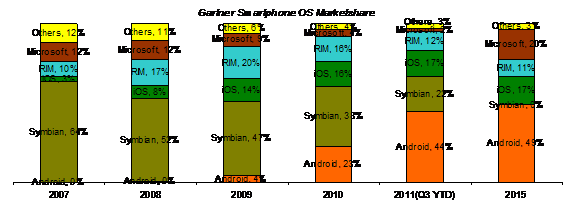
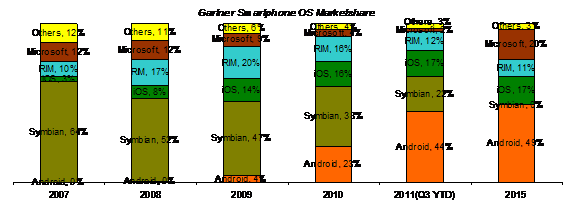
Android is a pack of software for mobile phones that contain an operating system with middleware and key applications which was originally developed Android Inc. that was acquired by Google in 2005 and T-Mobile launched the G1 Android phones manufactured by HTC in 2008. Android is now the largest OS in the smart phone market with 44% market share in Q3 2011. Android is an open source mobile platform where any one can create applications and sell them through Android Market. Android has close to half million apps in Android Market as of now. Android phones are being launched by mobile makers like Samsung, Motorola, HTC and other players that are easy to use and often come with functionality and features that are more powerful and useful than the Apple iPhone. Android phones were initially launched with bigger screens, resolutions, multi touch screens & powerful chips like 1GHz Qualcomm snapdragon processorcompared to 512 MB RAM of iPhone. Google is also investing in building its own smartphones as it recently announced to buy Android phone maker Motorola Mobility for $12.5 billion. Android Market is where developers sell their apps and the number of Apps in the Market has rose rapidly in the last two years. Android also has support from multiple networks AT&T, T-Mobile, Verizon, Sprint, etc.
Google still has central control over the code but allowed various manufacturers to flood the Market with Android phones at various price points and the wireless operators have pushed them into the market through advertizing and various subsidies on the devices and data plans. Consumers too embraced the device as suggested by market share figures. Google Android targeted the 81% percent market that were not using the smart phones and target this uncontested market as part of the blue ocean strategy, with devices that had features, functionality and apps. Google strategy is completely opposite to Apple strategy of total control of the hardware, software and ecosystem. Android completely opened its ecosystem to the developers and the mobile manufacturers and it has do it since it is targeting the rest of the 80% market that Apple ignored and it realized it cannot do it alone with its proprietary product. Google initially launched its own mobile device called Nexus and it realized how tough it is to manage the product that it developed.
Google announced the Open Handset Alliance to create an open platform (Android) for a Linux phone that can run mobile Google apps and others. The 34 partners include T-Mobile, Sprint Nextel, NTT Docomo, China Mobile, Telefonica, Telecom Italia, Motorola, Samsung, HTC, Qualcomm, Intel, etc. Google is also looking to control its android ecosystem and is asking licensees to follow certain guidelines. Google strategy has worked well and it gave dominance over the smartphone market.

Android Success factors and Criticism
The first and foremost factor for Android tremendous success is the Google decision to let Android be open source platform. Google formed the Open Handset Alliance with 34 partners that included Wireless carriers, mobile makers, chip makers and independent software vendors. All these partners have flooded the market with smartphones that not only increased the size of the smartphone percentage to the overall market of the mobile phones but also provided consumers with a wider choice of handsets with various features and functionalities. Google too supported these partners through the continuous improvement of the Android Platform (Upcoming 3.0 Version) and mobile makers launched handsets that are superior in performance in terms of hardware, software and designed handsets that attracted consumers to buy. Marketing and advertising strategy by the mobile makers and wireless carriers is also significant factor as there have been some good advertisement campaigns like the Motorola Droid etc, and the subsidies in terms of price and data plans by wireless carriers. The brand awareness of Android has increased tremendously and it is evident from the dominant market share of the Android phones in the Global Smartphone market. Added to this the reputation of Google itself also played a significant role and Google enjoys the confidence and trust which it gained from search and other apps. The failure of Research in Motion’s (RIM) Blackberry, Nokia’s Symbian phones and delay in launch of Microsoft Windows Phone 7 also help propel the Android into market dominance. Samsung, HTC and Motorola have launched handsets that have been able to attract the mobile users and are giving stiff competition to Apple iPhone.
Superphones are another category that is dominated by Android and the units are increasing slowly. Superphones are high-end smartphone devices that feature a display measuring more than 4-inches and are powered by a processor of at least 1GHz. The success of Android Marker Place where apps are sold and bought is another success factor. Developers are developing apps for Android devices and the number of apps has reached close too half million. But the fact remains the number of downloads and the revenues generated by the Android apps is lesser than the Apple’s iTunes and App store. The availability of many apps is attracting consumers to buy millions of Android phones along with price reductions and various subsidies. The average selling price of Android phones is lesser than the iPhone and so the margins. Android phones are also criticized in terms of the quality as the phones suffer more failures when compared to iPhone and the software updates are not provided to all the consumers as various mobile makers make handsets with different specs which cannot be upgraded on a common platform. Android updates come regularly but handset owners cannot update their phones as the mobile makers’ from whom they bought the devices don’t provide them. The sheer number of android devices and different manufacturers is a cause of concern and Google which has the central control on the Android is tightening the screws by asking the licensees to stick to the standard guidelines.
Steve Jobs criticized Android had stolen key features of iPhone and its operating system and vowed to destroy Android. Microsoft claims ownership of patents on several technologies used in Android and is collecting royalties from mobile device manufacturers like HTC and filed suit against Samsung, Motorola, etc. Apple is suing HTC and Samsung for patent infringement in terms of multi-touch, zoom, etc and filed suit in court and claims with the US ITC, asking to ban imports of Samsung and HTC devices running Android. Oracle is suing Android claiming it violates Java-related patents. Google is also supporting all the device manufacturers that are using Android in the legal cases relating to patent infringements and it is promising OEMs all the necessary support across the globe. Google recently acquired Motorola Mobility for US$ 12.5 billion which not only strengthens their mobile strategy with Motorola patents that came with the deal but also affect the way the Android ecosystem will be controlled and run in future.
Android Future Outlook
Android phenomenal rise in the last two years has caused ripples in the smartphone market. Every player in the smartphone market like Apple, RIM, Nokia and Microsoft have total control on the hardware, software like Operating System, and ecosystem as a whole but Google went against this total control to open source make Android available free to all the stakeholders and adopted a strategy where in they don’t want to compete with iPhone at the top end of smartphone market rather focus on the 80% market that are not iPhone users. This has worked really well for Android as the mobile makers have flooded the market with Android Phones and captured 45% of the smartphone market. Google close collaboration with manufacturers including the chip makers and carriers who needed devices and ecosystem to counter the dominance of Apple iPhone as Apple dealt with only AT&T and all other carriers flocked Google Android for competing. This has worked really well for the carriers, android phone makers, to the consumers. Android phone makers sold millions of devices that are high, mid and low end at all the price points. This also caused some problems like device failures, software updates and Android reliability is under question. Google started to focus on this issue and has come with standard guidelines for the licensees. Most of the software updates are not available for devices and consumers are facing difficulties in upgrading their software and some instances have to pay for updates also. Android has to come with a strategy to allow users update their phones.
The legal problems and the patent cases look ominous and expected to affect the Android mobile phone makers and overall android market share. Analysts and Research Firms expect the Android market share will be less than 50% by 2015 as the android makers have to pay royalties and fees in respect of the Legal cases and settlements and will definitely raise the cost and ultimately the prices. Oracle, Microsoft and other companies that are suing Android and mobile makers are not only asking for royalties but also seeking bans on the usage of specific technologies, functionalities & features and which will force the mobile makers to invest money and resources to develop ways to go around and develop their own technologies. Apple is trying to ban Android phones in various markets but did not have much success till now. Google legal battles are scaring the mobile makers and forcing them to look at alternatives for Android. These will definitely slowdown the Android growth. RIM and Microsoft that are not at all doing well presently, have developed own OS and devices and are launching them next year are confident to regain their lost market share. RIM and Microsoft are slow to come up with the advanced technologies, but analysts and research firms believe that Microsoft will recover its lost market share at the expense of Symbian and RIM is expected to hold on to 13-14% market share in 2015. Nokia adoption of Microsoft Windows Phone 7 as primary smartphone operating system and Samsung and HTC looking to launch more Windows Phone 7 phones with support from Microsoft will work in improving the Windows Phone 7 favor.
Google recent acquisition of the Motorola Mobility is also causing concern for the mobile makers. Mobile makers think Google will not provide total support for the other Android phone makers and will hold critical android updates with itself thus causing them problems. But there is still no clarity, how Google will use the Motorola Mobility whether it will use it to create benchmark designs, reference experiences and products for the android makers as Motorola has a great design and development team. Google has designed Android to offer three types of handset projects: Experience handsets (based on Google specs and branding), Partner handsets (compliant with Google’s Android specs, but with no Google involvement or branding) and DIYhandsets (take the source code and fork it, but you‘re on your own, e.g. China Mobile’s oPhone). Google also have to launch marketing and advertising campaigns along with the device manufacturers and wireless carriers to push more android phone into the market. Google does not look at Android as its core for making money but it wants Android to increase access to the Internet as it is looking to increase the increase the number of devices will help it increase its ad revenues through search, email, and other apps. Google is committed to Android and it is promising support to mobile makers that are launching Android phones as Android is essential for Google future revenue growth. More number of mobile devices with internet capability will provide an opportunity for Google to increase its revenues as the mobile users need browser for browsing internet, search engine and applications. But it needs to control the ecosystem in terms of uniformity of devices, prices features and how software is updated. Android is also extending into tablets and other devices like TVs, etc and the success in this segment will also play a major role in the future development and growth of Android.
Major threat for Android growth is Apple launch of new iPhone that is focused on the mid range market and emerging markets. If it is launched in next year then Android will see very tough competition along with the legal battles. Apple is an iconic cult brand that will rapidly erode the Android market. The legal battles may have affect on the prices in terms of prices of handsets raising but the price of Android devices even with the raised prices will be lower than Apple iPhone. The average selling price of high end Android devices is very close to iPhone but the margins per device is low and mobile makers have to look to improve their margins. Google Apps revenue is far lesser than Apple Apps revenues. Google realized that Apple initially created market for Android Devices in 2008 and because of Apple focus only on High end market and single device model led to the rapid growth in volumes but the smartphone has changed in 2011. Nokia, RIM and Microsoft have lost their market share as they were unable to meet the consumer demand and read the smartphone market correctly. Their loss was Android gain, but now Microsoft have realized their mistake and launched its latest Windows 7 OS and has tied up with Nokia, Samsung, HTC and other mobile makers to launch smartphones using their OS. RIM too is launching its QNX OS based Blackberry 10 series phones in 2012 and confident that it will regain its lost market share. Wireless carriers and mobile makers are looking for third ecosystem to counter Apple iOS and Google Android and hope Microsoft Windows Phone 7 will give them this edge and it is getting the same support that Android got initially that helped it to market dominance. Smartphone market has seen significant changes in 2011 and changes are expected to continue in 2012 and Google Android strategy has to be changed accordingly. Google needs to settle the legal battles, control more tightly the android ecosystem, keep close eye on its competitors as they are launching new products next year and look to increase its install base as it will help increase the Google revenues.